Sensual Atrophy: Why We Lose Our Spark and How to Get It Back
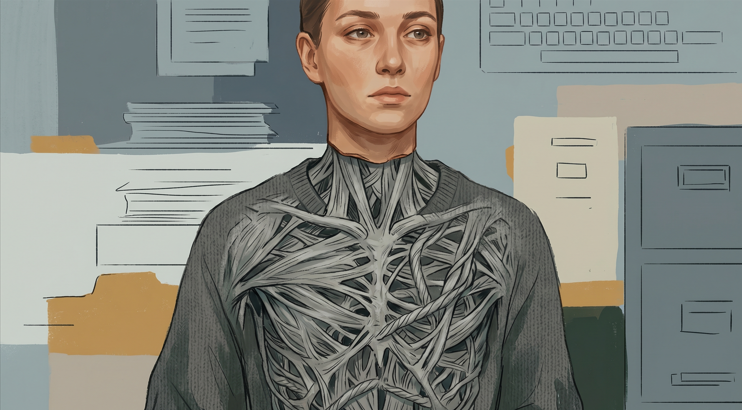
I have often wondered whether there is such a thing as Sensual Atrophy.
We are entirely familiar with the muscular kind. Immobilise a limb long enough and strength diminishes - not through illness, not through moral failing, but through the simple logic of disuse. The body is nothing if not economical. Nobody takes offence at this. It is merely physiology.
Yet when it comes to sensuality, we seem to assume the same principles do not apply. We treat our capacity to feel - to experience pleasure, curiosity, aliveness, creative hunger - as though it exists independently of whether we use it. As though it will simply wait, patient and uncomplaining, however long we leave it unattended.
And then we are surprised when something feels missing. Not wrong exactly. Not tragic. Just flatter.
Conversations become practical. Relationships become administrative. Sex becomes either another item on the to-do list or quietly disappears from it altogether. Creativity requires force rather than invitation. Joy becomes increasingly dependent on external stimulation - the holiday, the drink, the scroll - because the internal generative capacity has gone quiet. Food loses some of its magic. Music becomes background noise. Touch becomes functional rather than nourishing. Life continues, but with a diminishing range of sensation.
Interestingly, most people never connect any of this with sensuality.
They assume they are tired, or ageing, or stressed, or slightly depressed, or perhaps simply unlucky in the way that some people are unlucky with teeth. Some undoubtedly are. But I suspect there is another factor at work, one that receives almost no serious attention.
We have become extraordinarily proficient at living from the neck upwards.
We inhabit cultures that reward productivity, cognition and efficiency at the near-total expense of everything else. Busyness has somehow become evidence of importance. Exhaustion is worn like a medal. Rationality and resilience are celebrated. Meanwhile, our sensual life - and by sensual I do not mean sexual, though I include it - is treated as decorative at best, self-indulgent at worst.
In this sense, sensual atrophy is not entirely unlike dissociation - that well-documented phenomenon in which the self learns, often very early, to absent itself from present experience as a protective strategy. Dissociation is the mind's emergency exit. Sensual atrophy is what happens when the exit becomes the default route. One is acute; the other is chronic and quiet and almost entirely socially acceptable. (I'll write more about dissociation separately - the two are worth understanding in relation to each other.)
Which is curious, because the nervous system does not make such tidy distinctions.
The same organism that experiences pleasure experiences grief. The same tissues that hold excitement also hold disappointment. This is not a metaphor - the nervous system does not sort sensation into the acceptable and the difficult before processing it. To become more available to one is, necessarily, to become more available to all.
Which is where the real resistance lives.
Most people are not frightened of pleasure itself. They are frightened of what shares its address.
Because to genuinely expand one's sensual range is almost always to encounter material that has been very carefully organised out of awareness. Old losses. Old shame. Old angers that were never quite resolved. The body is efficient: what cannot be processed is postponed. Filed away, not because we are damaged or weak, but because there was simply nowhere to put it at the time, and life - with its legitimate and relentless demands - kept moving.
So it moves. Years pass. Careers are built. Children are raised. Mortgages are paid. Dogs are walked. Countries are moved to. Entire lives are constructed on top of unfinished emotional business, and for a long time this works perfectly well, because the human animal is remarkably adaptable.
But emotional debts accumulate interest.
Eventually, the bill arrives. Not usually in dramatic ways. More often it arrives as a kind of dullness - a loss of appetite for things that once mattered, a sense that life has become strangely two-dimensional, a diminishing responsiveness to beauty, connection, surprise. We may not be clinically depressed. We may not have experienced catastrophe. We simply no longer feel particularly moved by life, and we cannot quite say why.
I think this state is accepted far too readily.
We speak endlessly about physical fitness and, increasingly, about mental health. But we have almost no language for sensual fitness - for the idea that our capacity to feel deeply, to be present in the body, to remain curious and alive and available to experience, is itself a capacity that requires cultivation. That it can diminish through neglect and expand through attention, precisely as strength and flexibility can. That it is not a gift distributed at random but a practice - one that, unlike most worthwhile practices, requires no equipment, no particular schedule and no specialist vocabulary.
What it requires is a willingness to inhabit oneself again.
Which sounds simple, but is, in fact, surprisingly confronting. Because to inhabit oneself is to encounter oneself. And beneath the competent, functional adult who answers emails, manages school pick-ups and remembers to buy milk, lives a considerably more complicated creature: one with longing, contradiction, tenderness, unfinished conversations and desires that have no obvious place in a productive schedule.
Many people would rather remain busy than become intimate with that reality.
This is understandable. Feeling deeply has received genuinely terrible marketing. It has been associated, persistently, with weakness, irrationality and a kind of embarrassing excess. We tell children to get over things. We praise adults for their resilience - which often means, when you look closely, their cultivated ability to override themselves with increasing sophistication. Then, somewhere in their fifties or sixties, people wonder why they no longer feel desire, inspiration or wonder.
As though these things simply evaporated.
Perhaps they didn't evaporate.
Perhaps sensuality, creativity, vitality and intimacy belong to the same family - share the same root system, draw from the same well. Perhaps what we call flattening, or ageing, or simply the way things go, is sometimes none of those things.
Perhaps it is prolonged disuse.
Which is a rather different diagnosis - and, as diagnoses go, a considerably more hopeful one.
If this resonates with you - join Fiona for a 20-minute connection call
Stay connected with news and updates!
Join our mailing list to receive the latest news and updates from our team.
Don't worry, your information will not be shared.
We hate SPAM. We will never sell your information, for any reason.
