THE COST OF IRRELEVANT EFFORT
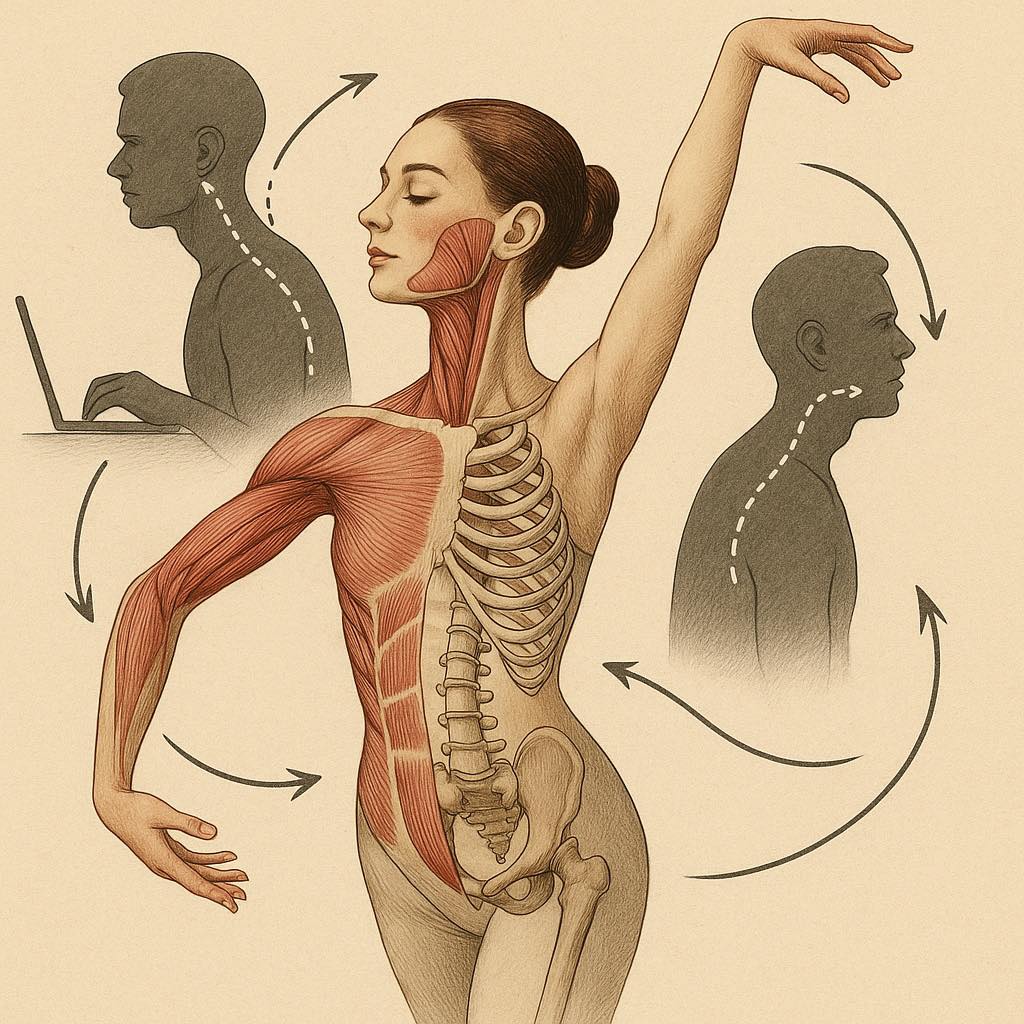
[On Ballet, Biomechanics, and the Art of Unwinding]
Elena K., a former dancer with the Bolshoi Ballet, once said that none of her thousand students ever needed surgery. Her rule was simple:
“You’re not allowed to hold tension that doesn’t belong to the movement.”
It turns out she was describing, decades ago, what modern biomechanics now confirms.
The Science of "Co-Contraction"
Harvard research on chronic co-contraction, the tiny, unnecessary tightening of muscles in the jaw, shoulders, or abdomen, shows that it can increase spinal compression by up to 40%, even while sitting.¹
In other words, most pain and “poor posture” are not caused by weakness, but by irrelevant effort.
The Micro-Grip of Daily Life
We grip through the day in microscopic ways:
-
Clenching the jaw while typing.
-
Bracing the stomach in conversation.
-
Tightening the neck when we think.
These are not muscular problems; they’re nervous-system patterns, traces of vigilance and anticipation that have outlived their purpose.
What Real Regulation Looks Like
When we begin to notice and refine these micro-movements, the body reorganises itself. It learns the difference between useful activation and defensive contraction.
This is what nervous-system regulation really is, and what “trauma release” actually refers to: not catharsis or shaking wildly, but the precise unwinding of effort that no longer serves function.
Finding Freedom
In my work, I’m less interested in what moves and more in what moves unnecessarily.
That’s where freedom and repair begin.
References & Resources
¹ Harvard Biomechanics Study on Co-Contraction and Postural Load, Harvard School of Engineering & Applied Sciences, 2018.
Learn more about somatic unwinding: www.fionasoma.com
If this resonates with you - join Fiona for a 20-minute connection call
Stay connected with news and updates!
Join our mailing list to receive the latest news and updates from our team.
Don't worry, your information will not be shared.
We hate SPAM. We will never sell your information, for any reason.
